
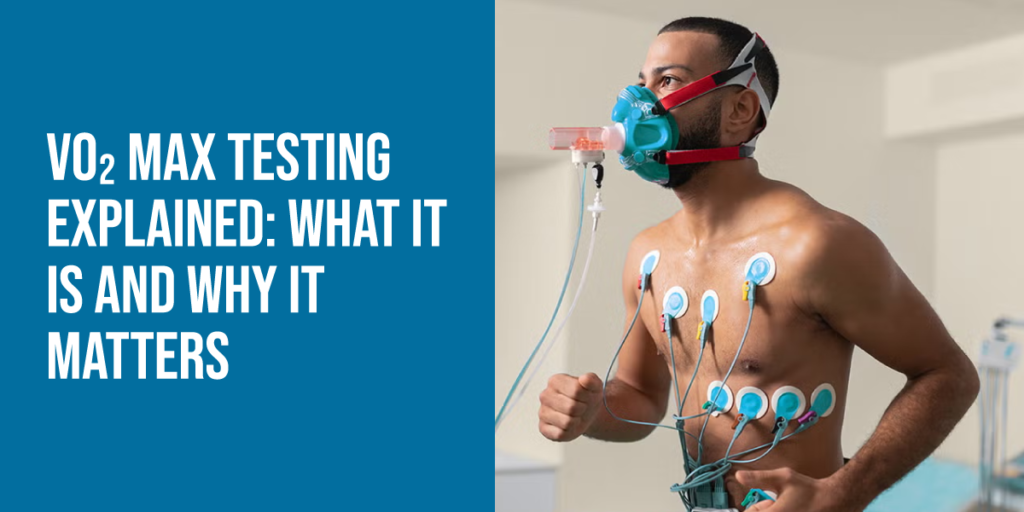
If you have ever felt like your workouts hit a frustrating wall—where breathing feels heavy, your legs feel like lead, and your split times refuse to budge—you are likely bumping up against your current cardiovascular ceiling.
Many athletes, runners, and fitness enthusiasts try to smash through this wall by simply working harder. They log more miles, push through intense intervals, or guess their target heart zones using generic smartwatch algorithms. But without precise metabolic data, you are essentially training in the dark.
To truly optimize your health, performance, and long-term lifespan, you need to measure your metabolic baseline. That is where VO₂ max testing comes in.
As the absolute gold standard cardio fitness test, it removes the guesswork. This comprehensive guide breaks down exactly what a VO₂ max test measures, the immense health and performance benefits it unlocks, how scores vary by demographic, and how you can systematically elevate your cardiorespiratory ceiling.
Quick Guide to VO₂ Max Testing
| What is a VO₂ max test? A VO₂ max test is a clinical-grade cardiovascular fitness test that measures the maximum volume of oxygen your body can consume, transport, and utilize during incremental, intense exercise. It acts as the definitive benchmark for an individual’s aerobic fitness and metabolic efficiency. Process Summary Equipment Used: A specialized oxygen mask, a heart rate monitor, and a metabolic cart connected to a treadmill or stationary bicycle. Testing Dynamic: A progressive, step-by-step increase in exercise intensity until physical exhaustion is reached. Core Metrics Tracked: Volume of oxygen consumed (VO₂), carbon dioxide exhaled (VO₂), ventilation rate (VE), and precise heart rate zones. |
What is VO₂ Max Testing?
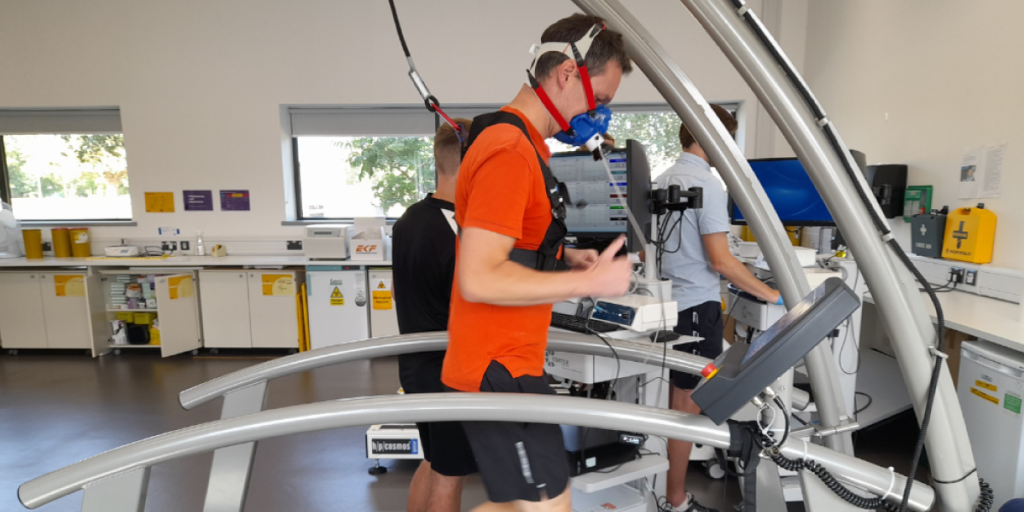
To truly grasp the mechanics of an oxygen uptake test, it helps to look at the name itself. The term breaks down into three distinct parts:
- V stands for Volume.
- O₂ stands for Oxygen.
- Max stands for Maximum capacity.
Expressed mathematically, your relative score is measured in milliliters of oxygen consumed per kilogram of body weight per minute (mL/kg/min). If you have a score of 45 mL/kg/min, it means your body can extract and route 45 milliliters of oxygen for every single kilogram of your body weight, every sixty seconds, during maximum exertion.
During a standard session at a dedicated performance facility like Back Bay Fit, you put on a sealed respiratory mask and step onto a treadmill or stationary bike. The mask does not restrict your breathing; instead, it captures every single inhale and exhale.
As you walk, jog, and eventually sprint, the laboratory’s metabolic analysis cart calculates the exact ratio of oxygen you absorb versus the carbon dioxide you breathe out.
| FURTHER READING: Exploring Traditional Strength Training: Methods and Benefits |
The Cellular Pathway of Oxygen

When you perform an endurance testing evaluation, your body triggers a complex physiological chain reaction:
- Pulmonary Intake: Your lungs draw in atmospheric oxygen.
- Cardiac Transport: Your heart pumps oxygenated blood out to working skeletal tissues.
- Vascular Extraction: A vast network of microscopic capillaries delivers that blood directly into individual muscle fibers.
- Cellular Energy Production: The mitochondria inside your cells consume that oxygen to efficiently generate Adenosine Triphosphate (ATP), the primary energy currency your body uses to sustain movement.
When you reach the absolute limit of this pathway, your oxygen consumption levels off, even if the treadmill gets faster or steeper. That exact leveling-off point is your maximum aerobic capacity.
Why It Matters: The Longevity and Performance Connection
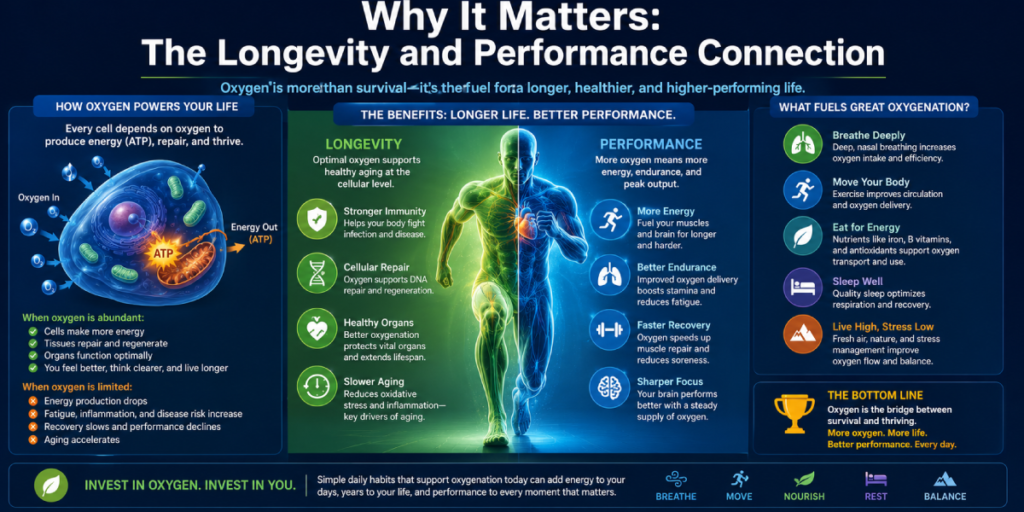
For decades, accurate metabolic testing was reserved exclusively for elite cyclists, triathletes, and marathoners looking to slice seconds off their race times. Today, clinical research has revealed that this metric is perhaps the single most critical indicator of overall health, healthspan, and all-cause mortality.
The Ultimate Longevity Indicator
Data published across major medical journals, including landmark reviews in JAMA Network Open, show that cardiorespiratory fitness is an incredibly strong predictor of long-term survival.
When you move from a “low” fitness category to an “elite” fitness category, the hazard ratio for all-cause mortality drops substantially. In plain terms: having a high aerobic capacity is deeply protective against chronic age-related diseases.
Cardiorespiratory Health and Disease Prevention
A robust aerobic system acts as a shield for your heart and blood vessels. Regular tracking via a fitness assessment provides early insights into your metabolic wellness. Elevating your score helps protect your body against:
- Hypertension and chronic arterial stiffening.
- Insulin resistance and type 2 diabetes.
- Systemic, low-grade chronic inflammation.
- Age-related cognitive decline and neurodegenerative changes.
The Core VO₂ Max Benefits

Investing the time to complete a structured metabolic lab test provides actionable benefits that extend far beyond a single data point.
- Pinpoint Heart Rate Training Zones: Most generic formulas calculate your heart rate zones using simple equations like 220 minus your age. This method can easily be off by 10 to 15 beats per minute. A metabolic test identifies your exact Aerobic Threshold (AeT) and Anaerobic Threshold (AnAT), allowing you to train with absolute precision.
- Track Real Cardiovascular Progress: Avoid relying on vague approximations. By testing periodically, you get clear proof that your heart is pumping more blood per stroke and your muscles are extracting oxygen more efficiently.
- Optimize Fuel Utilization: The test reveals your specific crossover point—the exact heart rate where your body shifts from burning fats to burning carbohydrates. This data is invaluable for optimizing endurance pacing and weight management strategies.
| FURTHER READING: How to Train Grip Strength: The Ultimate Guide to Stronger Hands |
Understanding VO₂ Max by Age and Gender
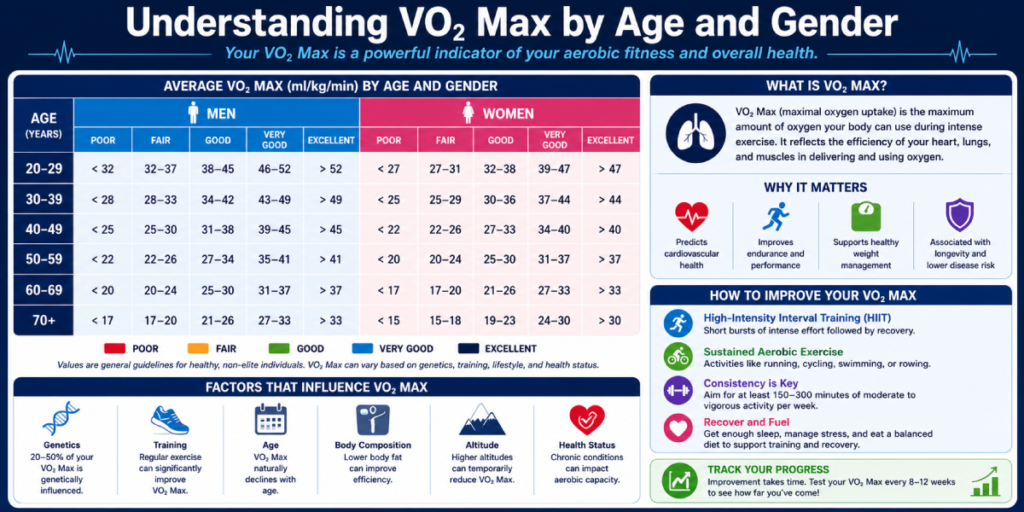
Your absolute aerobic capacity is influenced by a mix of genetics, biological sex, age, and activity levels. Because lung volume, heart size, and muscle mass vary naturally between biological sexes, baseline brackets are categorized separately.
As we get older, natural physiological shifts—such as a gradual decline in maximum heart rate and a subtle loss of muscle tissue—cause scores to drop by roughly 7% to 10% per decade after age 30. However, structured, data-driven cardiovascular training can significantly slow down or even reverse this baseline decline.
VO₂ Max Reference Norms (mL / kg / min)
| Age Group | Poor / Low | Fair / Average | Good / Superior | Elite |
| Men 20–29 | Less than 38 | 39 – 43 | 44 – 51 | 52+ |
| Women 20–29 | Less than 32 | 33 – 36 | 37 – 44 | 45+ |
| Men 30–39 | Less than 35 | 36 – 40 | 41 – 47 | 48+ |
| Women 30–39 | Less than 30 | 31 – 34 | 35 – 41 | 42+ |
| Men 40–49 | Less than 33 | 34 – 38 | 39 – 44 | 45+ |
| Women 40–49 | Less than 27 | 28 – 31 | 32 – 37 | 38+ |
| Men 50–59 | Less than 30 | 31 – 35 | 36 – 41 | 42+ |
| Women 50–59 | Less than 24 | 25 – 28 | 29 – 34 | 35+ |
Step-by-Step: The VO₂ Max Testing Process
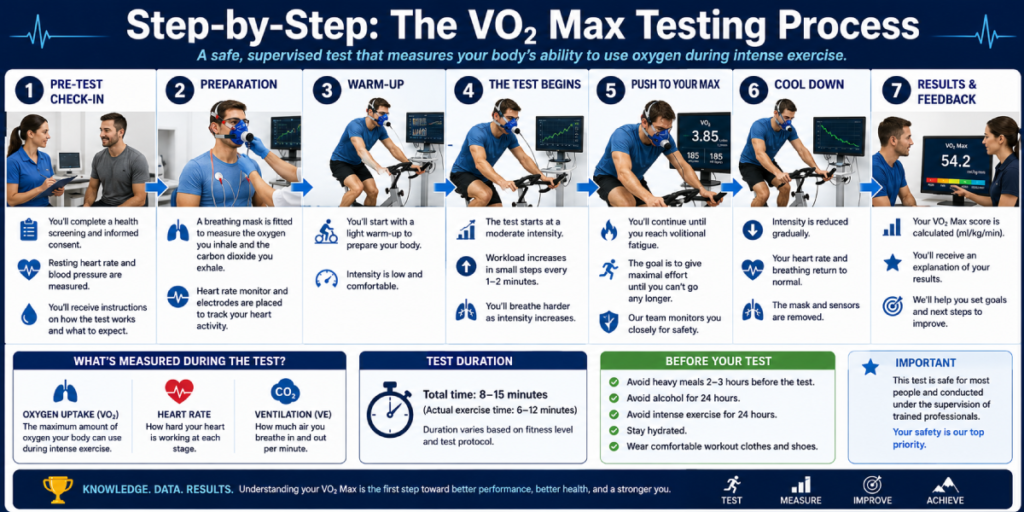
Understanding what happens during a diagnostic appointment helps ease any testing anxiety and ensures you gather clean, actionable metrics.
1.Pre-Test Preparation:
24 Hours Before.
Avoid exhausting workouts for 24 hours prior to your assessment. Fast for 2 to 3 hours before arriving, and skip stimulants like caffeine or pre-workout supplements, which can artificially skew your resting and active heart rates.
2.Equipment Integration:
10 Minutes Before.
A performance specialist fits a flexible silicone mask over your nose and mouth. This mask connects to a sensitive flow turbine that captures gas volume. You will also put on a clinical-grade chest strap heart rate monitor.
3.The Baseline Warm-Up:
3 to 5 Minutes.
You will begin with an easy walk or light spin. This allows the metabolic cart to calibrate against your resting carbon dioxide output and lets your body ease into movement.
4.The Progressive Ramp Protocol:
8 to 12 Minutes.
Every 60 to 90 seconds, the specialist increases either the speed, the incline, or the mechanical resistance. The effort transitions smoothly from an easy jog to an intense climb, eventually building to an all-out sprint.
5.Peak Exhaustion & Active Recovery:
1 to 2 Minutes.
Once you reach your absolute physical limit and cannot maintain the cadence, you signal the technician. The machine drops back to a slow walk for a safe cool-down while the system tracks how quickly your heart rate recovers.
| FURTHER READING: How does Pilates impact metabolism compared to other exercises? |
Common Mistakes People Make with Aerobic Testing
- Relying Solely on Wearable Estimations: Smartwatches use heart rate variability and running pace to guess your capacity via a built-in VO₂ max calculator. While these algorithms are improving, changes in weather, running terrain, dehydration, or stress can easily throw off their estimates. A true gas-exchange mask test provides the real physiological data your watch is trying to guess.
- Testing While Chronically Fatigued: Arriving at the lab directly after a week of intense training means your body will likely hit muscular exhaustion long before your cardiorespiratory system actually reaches its true peak.
- Ignoring the Threshold Data: Many people focus entirely on their final score. However, the real value for your daily training lies in identifying your exact heart rate thresholds. This is the data that allows you to structure highly effective training zones.
How to Improve Your VO₂ Max: The Training Protocols
If your initial test results are lower than you hoped, don’t worry. Your aerobic capacity is highly adaptable. The secret to moving your numbers upward lies in balancing two distinct styles of cardiovascular stimulus.
1. The Foundation: Zone 2 Aerobic Base Training
To improve your capacity, you must first build a wide aerobic base. Zone 2 training involves sustained, steady-state exercise at a conversational pace—think long runs, rowing, or cycling where you can maintain a full sentence without pausing for air.
- Physiological Impact: It prompts your body to build more capillaries and increases both the size and number of mitochondria within your muscle cells.
- Volume Recommendation: Aim for 70% to 80% of your total weekly training volume within this comfortable zone.
2. The Ceiling Lifter: High-Intensity Interval Training (HIIT)
While Zone 2 builds the foundation, high-intensity intervals force your heart to pump its maximum volume of blood per stroke, increasing its physical stroke volume.
- The Norwegian 4×4 Protocol: This highly studied protocol is exceptionally effective at driving up aerobic scores.
- Execution: Perform a 4-minute high-intensity interval at roughly 85% to 95% of your maximum heart rate. Follow it with 3 minutes of easy walking recovery. Repeat this sequence for a total of four rounds.
Expert Tips for Test Day
Prioritize Glycogen Stores: Eat a light meal consisting of easily digestible carbohydrates (like oatmeal or a banana) roughly two to three hours before testing. Your body needs accessible glucose to hit true maximum intensity.
Wear the Right Apparel: Choose lightweight, moisture-wicking clothing and the specific running shoes you use for your standard workouts. Avoid loose, heavy clothing that could catch on a fast-moving treadmill.
Embrace the Mental Challenge: The final two minutes of a metabolic test require focused mental effort. Keep in mind that the test is designed to push you to complete physical exhaustion—staying relaxed through the toughest segments ensures you reach a true physiological peak.
Frequently Asked Questions
⮞ What is a VO₂ max test?
It is a metabolic analysis performed during progressive exercise that measures the maximum rate at which your body can take in, transport, and use oxygen to produce cellular energy.
⮞ Why is VO₂ max important?
It serves as the definitive objective baseline for your cardiorespiratory health and physical performance. Clinical research highlights it as a powerful indicator of overall lifespan, cardiorespiratory resilience, and long-term metabolic health.
⮞ What is a good VO₂ max score?
A “good” score depends entirely on your age and biological sex. For individuals in their 30s, a good baseline score generally starts around 41 mL/kg/min for men and 35 mL/kg/min for women. Active endurance athletes frequently cross into scores of 60 to 70+.
⮞ How can I improve my VO₂ max?
You can efficiently build your score by combining regular, low-intensity Zone 2 baseline cardio with targeted, high-intensity intervals (like the classic Norwegian 4×4 training protocol) once or twice a week.
⮞ Who should get a VO₂ max test?
Anyone looking to take the guesswork out of their health and fitness journey can benefit from an assessment. It provides critical, baseline data for everyday runners trying to break personal records, individuals focusing on longevity, and fitness enthusiasts wanting to design precise heart rate zones.
⮞ How often should you test your VO₂ max?
Because structural cellular adaptions take time to develop, scheduling an assessment every 4 to 6 months is ideal. This window allows you to clearly map your progress, adjust your training zones, and fine-tune your programming as your fitness improves.
⮞ How to calculate VO2 max?
Cooper 12-Minute Run Formula:
| VO₂ max = [ Distance (meters) – 504.9 ] / 44.73 |
Steps:
- Run as far as you can in 12 minutes.
- Measure the distance you ran in meters.
- Put the distance into the formula.
Conclusion: Committing to the Data-Driven Journey
Unlocking your true physical potential requires moving past generic fitness calculators and embracing the reality of your individual physiology. A VO₂ max test is much more than a routine score or a performance metric for competitive athletes—it serves as a foundational baseline for your metabolic efficiency, everyday energy production, and long-term healthspan.
By identifying your exact cardiorespiratory thresholds, you replace speculative effort with calculated, deliberate steps. You gain the exact data needed to organize your weeks efficiently, optimize your recovery periods, and systematically elevate your cardiovascular ceiling. The path to building a resilient, long-lasting aerobic system is rooted in precise diagnostics, patient base building, and structured recovery.
Take the Next Step with Back Bay Fit
Ready to stop guessing your target heart rate zones and start training with physiological accuracy? Take full control of your athletic progression and physical health. Schedule your professional VO₂ max testing assessment at Back Bay Fit in Boston today, and let our dedicated team design a personalized blueprint for your long-term health, strength, and endurance.
