
True physical performance is rarely limited by your muscles. More often, it is limited by your mind. Whether you are aiming to push through a grueling final set in the weight room, navigate a high-stress career milestone, or handle life’s unexpected setbacks, learning how to build mental strength is the foundational skill that determines your trajectory.
Mental strength is not an innate trait reserved for elite athletes or military personnel; it is a trainable physical and psychological capacity. Just as progressive overload stimulates muscle hypertrophy, controlled exposure to discomfort builds cognitive resilience.
This comprehensive guide breaks down the science of mental fortitude, common pitfalls to avoid, and a step-by-step framework to cultivate an unbreakable mindset through daily habits and data-driven physical training.
What is Mental Strength?

To understand how to gain mental strength, you must first define what it actually represents. Mental fortitude—often used interchangeably with mental toughness or psychological resilience—is the ability to regulate your emotions, manage your thoughts, and maintain constructive behavior despite significant stress, pressure, or fatigue.
| Core Dimension | Primary Focus | Actionable Application |
| Emotional Control | Managing physiological reactivity | Regulating acute stress responses and preventing emotional volatility. |
| Cognitive Focus | Eliminating internal noise | Maintaining unwavering clarity and task orientation under pressure. |
| Behavioral Grit | Sustaining effort through fatigue | Executing critical actions regardless of immediate feelings or comfort. |
Having a strong mindset meaning does not imply suppressing emotions or ignoring reality. Rather, it means developing the self-awareness to acknowledge difficulty while retaining control over your response.
The Difference Between Mental Strength, Toughness, and Endurance
While these terms are frequently conflated, understanding their nuances helps tailor your training:
- Mental Fortitude Meaning: The courage and psychological strength to face adversity, danger, or pain without yielding.
- Mental Endurance: The capacity to maintain intense focus and effort over prolonged periods of physical or cognitive strain.
- Mental Tenacity: The persistent determination to pursue long-term goals despite repeated friction, delays, or failures.
| 🏋 Further Reading: Strength Training for Longevity: Why Building Muscle Matters as You Age |
Why Mental Strength Matters (And the Science Behind It)

Cultivating psychological resilience yields direct dividends across physical health, career performance, and overall longevity.
| Step | Neurobiological Event | Practical Outcome |
| 1. Voluntary Discomfort | Engaging in difficult tasks (e.g., heavy lifts, cold exposure). | Signals the brain to adapt to controlled physical or mental strain. |
| 2. aMCC Activation | Stimulation of the Anterior Midcingulate Cortex. | The brain’s “willpower hub” physically expands through repeated challenge. |
| 3. Neural Plasticity | Formation of denser, more resilient neural pathways. | Lowers baseline reactivity and increases future tolerance to friction. |
| 4. Long-Term Adaptation | Enhanced autonomic nervous system regulation. | Improves heart rate variability (HRV) recovery and overall lifespan. |
Neurologically, voluntary challenge activates a brain structure known as the anterior midcingulate cortex (aMCC). Neuroscientific research suggests that the aMCC grows when you engage in tasks you find challenging or uncomfortable. When you choose to do something difficult, you physically alter your brain’s architecture, making subsequent challenges easier to navigate.
Primary Benefits of Building Fortitude
- Improved Stress Adaptation: Lower baseline cortisol spikes during high-pressure scenarios.
- Enhanced Physical Output: Higher pain tolerance and delayed cognitive fatigue during high-intensity training.
- Accelerated Recovery: Reduced rumination and faster heart-rate variability (HRV) stabilization after stressful events.
- Better Decision-Making: Elimination of impulsive, emotion-driven actions during crises.
| 🏋 Further Reading: What Does Back Bay Fit Do for Back Pain as Health Practitioners Trainer? |
Quick-Reference Guide: How to Build Mental Strength
Definition
Mental Strength is the psychological capacity to perform, adapt, and remain focused under stress, discomfort, or adversity by controlling emotional and cognitive responses.
Quick Action Steps
- Control the Controllables: Audit your daily environment and eliminate energy drains.
- Embrace Controlled Discomfort: Introduce physical and mental stressors (e.g., strength training, cold exposure, difficult learning tasks).
- Reframe Internal Narrative: Shift self-talk from victim-oriented (“Why is this happening?”) to action-oriented (“How do I execute?”).
- Practice Physiological Regulation: Use box breathing or physiological sighs to reset your autonomic nervous system.
- Track Data: Monitor HRV, sleep quality, and performance metrics to measure physical and mental adaptation.
| 🏋 Further Reading: Fitness Transformation in Females: Real-Life Journeys |
The 4 Pillars of Mentally Strong Fitness
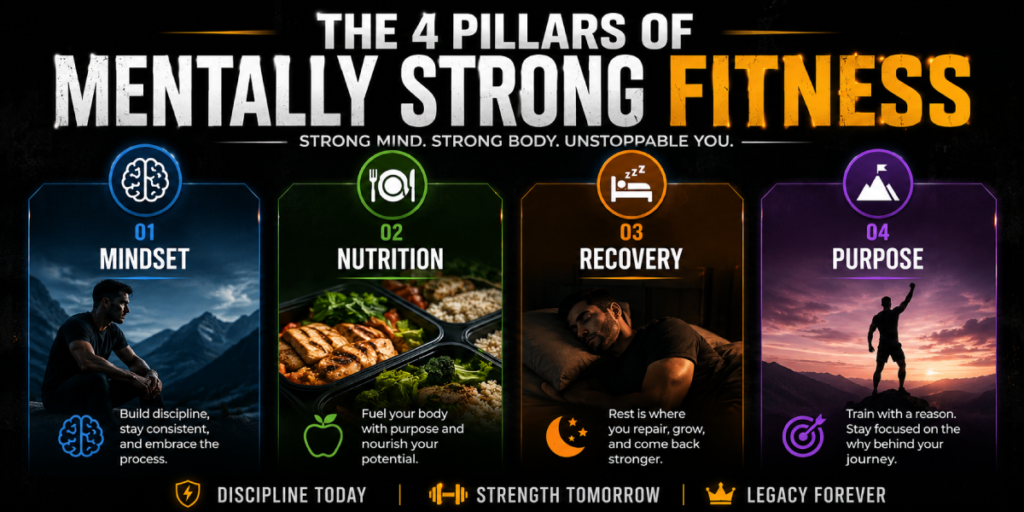
At Back Bay Fit, we view physical conditioning as the single most effective vehicle for building psychological resilience. You cannot separate mind and body; your nervous system experiences physical strain and psychological pressure through overlapping biological pathways.
| Pillar | Physical Focus | Mental Application |
| 1. Stress Tolerance | High-Intensity Resistance Training | Learning to stay calm while operating near maximum heart rate. |
| 2. Progressive Overload | Increasing weight, reps, or density | Deliberately seeking heavier loads to build confidence under strain. |
| 3. Recovery Regulation | Cold therapy, breathwork, sleep | Actively down-regulating the nervous system after intense exertion. |
| 4. Consistency Discipline | Showing up regardless of motivation | Decoupling action from immediate emotional state. |
Common Mistakes That Drain Mental Strength

Before adding new habits, audit your routine to remove behaviors that erode resilience.
| Fortitude Drain | Cause | Strategic Correction |
| Emotional Avoidance | Consistently escaping uncomfortable situations. | Lean into friction via micro-challenges to expand stress tolerance. |
| Over-Reliance on Motivation | Waiting to “feel ready” before taking action. | Establish strict, non-negotiable systems and daily routines. |
| Lack of Recovery | Depleting neurotransmitters via chronic overwork. | Prioritize sleep hygiene, parasympathetic down-regulation, and nutrition. |
| Victim Mindset | Viewing setbacks as personal flaws rather than data. | Practice objective reframing: analyze failure as neutral feedback. |
Step-by-Step Process: How to Build Mental Toughness
Cultivating resilience requires a structured framework. Follow this 5-step process to systematically build your mental endurance.
Step 1: Establish Your Baseline
Map your current stress tolerance. Identify your friction points—whether it is breaking down under high-intensity workouts, procrastinating on difficult business decisions, or losing emotional control under fatigue.
Step 2: Introduce Micro-Discomforts Daily
Select one voluntary, controlled stressor every day. Examples include:
- Completing an extra challenging set at the end of a workout.
- Taking a 2-minute cold shower at the end of your morning routine.
- Fasting from screen time or social media for 12 hours.
Step 3: Implement Physiological Down-Regulation
When stress triggers a fight-or-flight response, interrupt the neurological cascade through physical intervention.
- The Physiological Sigh: Inhale twice deeply through the nose, followed by a long, slow exhale through the mouth. Repeat 3 times to rapidly reduce heart rate.
- Box Breathing: Inhale for 4 seconds, hold for 4 seconds, exhale for 4 seconds, hold for 4 seconds.
Step 4: Reframe the Internal Monologue
Replace cognitive distortions with objective facts. Instead of telling yourself “I can’t finish this workout,” reframe the thought to “This set is creating muscle adaptation; I have handled this level of fatigue before.”
Step 5: Leverage Data-Driven Progression
Quantify your growth. Track metrics like heart rate recovery, sleep efficiency, weight lifted, and adherence to difficult tasks. Seeing tangible proof of your progress reinforces self-efficacy.
| 🏋 Further Reading: What Is Sport-Specific Training? Described! |
Comparison: Low Resilience vs. High Resilience Mindset
| Scenario | Low Resilience Mindset | High Resilience Mindset |
| Hitting a plateau in training | Quits the program or blames genetics. | Audits sleep, nutrition, and programming adjustments. |
| High-stress workday | Skips training, relies on comfort food. | Uses training as a controlled stress release mechanism. |
| Experiencing unexpected failure | Internalizes defeat; avoids future risks. | Analyzes data points, adjusts strategy, re-engages. |
| Facing physical fatigue | Drops effort prematurely. | Uses breath control to maintain execution quality. |
Expert Tips for Developing Mentally Strong Fitness

As elite coaches, we recommend integrating these advanced strategies into your routine:
- Train with Objective Metrics: Subjective effort can deceive you. Use velocity-based training, VO2 max testing, or heart rate zone monitoring. Numbers do not care about your feelings, which forces absolute honesty.
- Practice “Zone 2” Mental Endurance: Long, steady-state aerobic work in Zone 2 forces you to sit with monotony and mild discomfort for 45–60 minutes—building pure psychological endurance.
- Utilize Physical Therapy for Mindset Realignment: Recovering from an injury is one of the toughest mental challenges. Working with a specialized physical therapist helps re-establish trust in your body’s capacity.
| 🏋 Further Reading: What is an RMR Test? Here’s Everything You Should Know |
Frequently Asked Questions
How do I train myself to be mentally strong?
Training yourself to be mentally strong requires progressive exposure to controlled stressors. Start small by introducing intentional physical discomfort (such as resistance training or cold exposure), practicing breathwork during acute stress, and eliminating victim-oriented self-talk. Consistency in keeping promises to yourself builds internal trust and resilience over time.
What are the 7 C’s of mental toughness?
The 7 C’s framework provides a comprehensive blueprint for resilience:
- Control: Believing you can influence your outcomes.
- Commitment: Staying dedicated to goals despite obstacles.
- Challenge: Viewing difficulties as opportunities to grow.
- Confidence: Believing in your abilities to execute under strain.
- Connection: Building strong support networks.
- Character: Aligning actions with core values under pressure.
- Compassion: Practicing self-compassion without sacrificing accountability.
How can I rebuild my mental strength?
Rebuilding mental strength after burnout or trauma begins with foundational recovery. Prioritize sleep, nutrition, and basic physical movement first. Once your nervous system stabilizes, reintroduce micro-challenges gradually. Focus on small, non-negotiable daily wins to rebuild self-efficacy before tackling high-stress environments.
How to fix being mentally weak?
Being “mentally weak” is simply an untrained state, not a permanent personality flaw. To fix it, stop avoiding friction. Design your environment to minimize temptation, decouple your actions from your feelings, and engage in regular strength training. Pushing your physical boundaries teaches your brain that you can endure discomfort and come out stronger.
Build Your Mind and Body at Back Bay Fit
Learning how to build mental strength is not a passive mental exercise—it is built through tangible, physical execution. When you train your body to handle heavy loads, demanding metabolic output, and structured recovery, your mind naturally adapts to match that level of fortitude.
At Back Bay Fit, we provide Boston’s premier environment for data-driven fitness, physical therapy, and high-performance coaching. Whether you are looking to rebuild after an injury, optimize your longevity, or push your physical and mental limits, our team utilizes advanced testing and elite coaching to help you achieve measurable results.
Ready to forge unbreakable strength? Book your initial consultation and assessment with Back Bay Fit today.
