
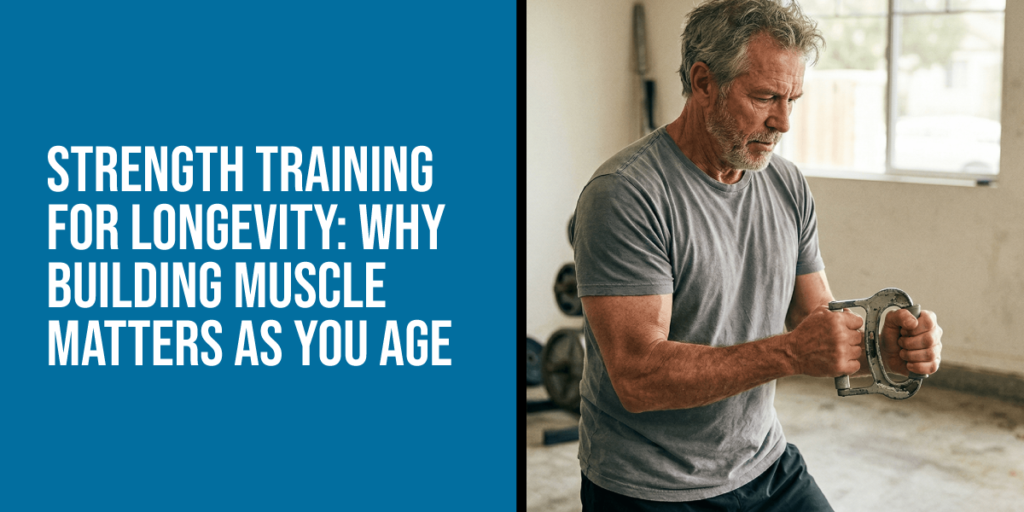
Are you worried about losing your mobility, joint health, or energy as you get older? Strength training for longevity is the single most effective, evidence-based strategy to prevent muscle loss, protect your metabolic health, and extend your overall healthspan. While cardiovascular fitness is essential for heart health, building and maintaining muscle mass is the key to staying functional, independent, and resilient well into your 70s, 80s, and beyond.
What Is Strength Training for Longevity?
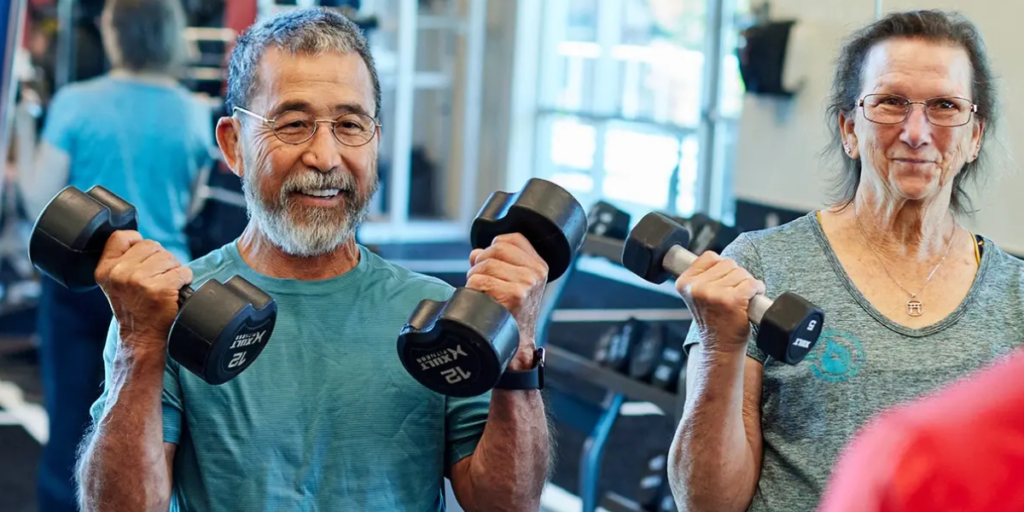
Strength training for longevity refers to resistance-based exercise designed to preserve lean muscle mass, protect bone density, enhance joint integrity, and support metabolic health throughout your lifespan. Unlike body-building routines aimed solely at muscle size, longevity-focused fitness prioritizes functional strength, structural durability, and metabolic efficiency.
The Longevity Strength Framework
| Pillar | Core Focus | Key Health Outcome |
| Structural Integrity | Bone density, joint stability, and connective tissue strength | Prevents fractures, supports joint alignment, and reduces injury risk |
| Metabolic Health | Glucose sink, insulin sensitivity, and resting metabolism | Regulates blood sugar, optimizes body composition, and lowers diabetes risk |
| Functional Mobility | Balance, power output, and real-world movement capacity | Preserves independence, prevents falls, and maintains daily movement quality |
This approach shifts the objective from short-term peak performance to sustainable, lifelong capacity—ensuring that your movement quality at age 70 or 80 matches the demands of your daily life.
The Science of Sarcopenia: Why Muscle Mass Declines with Age
After age 30, adults lose approximately 3% to 8% of their muscle mass per decade. By age 60, that decline can double.
This age-related loss of muscle mass, quality, and strength—known as sarcopenia—is driven by several biological mechanisms:
- Anabolic Resistance: As we age, our bodies become less efficient at converting dietary protein into new muscle tissue.
- Hormonal Changes: Declining levels of growth hormone, testosterone, estrogen, and IGF-1 reduce the body’s natural drive for tissue repair and muscle synthesis.
- Loss of Fast-Twitch Motor Units: Aging disproportionately impacts Type II (fast-twitch) muscle fibers—the ones responsible for power, quick reactions, and heavy lifting.
- Chronic Inflammation: Low-grade, age-related systemic inflammation (“inflammaging”) breaks down muscle tissue faster than the body can rebuild it.
Key Takeaway: Sarcopenia is not an unavoidable consequence of getting older; it is largely a consequence of disuse. Resistance training acts as a direct stimulus to halt and reverse this decline.
Strength Training vs. Cardio for Longevity

| Health Marker | Resistance Training | Steady-State Cardio |
| Sarcopenia Prevention | Primary Driver (High Impact) | Minimal Impact |
| Bone Density Protection | Primary Driver (High Impact) | Low-to-Moderate Impact |
| Glucose Disposal / Insulin Sensitivity | High Impact (Increases Storage Area) | High Impact (Increases Transport Efficiency) |
| Resting Metabolic Rate | High Impact (Preserves Lean Mass) | Minimal Impact |
| Balance & Fall Prevention | Primary Driver (High Impact) | Low Impact |
| Cardiovascular Health | Moderate Impact | Primary Driver (High Impact) |
A complete longevity routine combines both, but resistance training provides unique structural and metabolic protections that cardio alone cannot replicate.
4 Essential Benefits of Resistance Training as You Age
Longevity Pillars of Resistance Training
| Benefit Area | Biological Mechanism | Real-World Impact |
| 1. Metabolic Health & Insulin Sensitivity | Muscle serves as the body’s largest glucose sink, absorbing up to 80% of circulating blood sugar. | Improves glycemic control and reduces long-term metabolic disease risk. |
| 2. Bone Density & Joint Protection | Mechanical loading triggers osteoblasts to build bone matrix while strengthening tendons. | Reduces risk of osteopenia, osteoporosis, and age-related joint pain. |
| 3. Neuromuscular Function & Fall Safety | Preserves motor unit connectivity and restores Type II fast-twitch muscle fibers. | Enhances balance, speed of recovery during trips, and spatial coordination. |
| 4. Cognitive & Emotional Resilience | Triggers release of Brain-Derived Neurotrophic Factor (BDNF) to stimulate neuroplasticity. | Supports memory retention, mood stability, and lower cognitive decline risk. |
5 Common Mistakes in Anti-Aging Fitness

- Relying Solely on Cardio: Cycling, walking, and swimming support heart health, but they do not provide the mechanical load necessary to halt bone loss or preserve muscle mass.
- Lifting Weights That Are Too Light: Muscle growth (hypertrophy) requires adequate mechanical tension. Training exclusively with 2-pound dumbbells will not challenge your neuromuscular system enough to spark growth.
- Ignoring Progressive Overload: Doing the exact same weight, repetitions, and exercises for years causes your body to adapt and plateau. You must gradually increase difficulty over time.
- Neglecting Recovery and Protein Intake: Older adults require more protein per meal—typically 30–40 grams of high-quality protein—to overcome anabolic resistance and stimulate muscle synthesis.
- Sacrificing Form for Weight: Ego lifting leads to joint inflammation and injury. Longevity training prioritizes full range of motion, mechanical control, and tissue safety.
How to Build a Longevity-Focused Strength Program: Step-by-Step
A balanced longevity program centers on multi-joint, functional compound movements that mimic real-life demands.
Essential Compound Movement Patterns
| Movement Pattern | Target Musculature | Functional Purpose | Exercise Examples |
| Squat / Lunge | Quadriceps, Glutes | Lower body force production & knee stability | Goblet Squats, Split Squats, Step-Ups |
| Hinge | Hamstrings, Glutes, Erector Spinae | Posterior chain power & spine support | Romanian Deadlifts, Kettlebell Swings |
| Upper Body Push | Pectorals, Deltoids, Triceps | Upper body pressing strength & shoulder stability | Dumbbell Bench Press, Overhead Press |
| Upper Body Pull | Latissimus Dorsi, Rhomboids, Biceps | Postural support & upper back structural balance | Seated Cable Rows, Lat Pulldowns |
| Loaded Carry | Core, Forearms, Upper Trapezius | Grip strength, trunk stability & postural control | Farmer’s Carries, Suitcase Carries |
Step 1: Establish Proper Frequency and Volume
Aim for 2 to 4 strength sessions per week, allowing 48 hours of recovery between sessions targeting the same muscle groups. Focus on 3 to 4 sets per exercise using a rep range of 6 to 12 reps with heavy-to-moderate loads.
Step 2: Integrate Baseline Movement Quality
Before loading a movement pattern, ensure your joints move through a healthy range of motion. Incorporating targeted mobility work, joint prep, and physical therapy principles ensures long-term sustainability without joint wear.
Expert Tips for Muscle Building After 40

- Prioritize Recovery: As you age, your body requires more time to repair tissue. Prioritize 7–9 hours of sleep and keep rest periods between heavy sets to 2–3 minutes.
- Leverage Data and Testing: Utilize tools like DEXA scans to track lean tissue vs. fat mass, and baseline strength assessments to monitor power output over time.
- Optimize Protein Timing: Distribute protein intake evenly across meals, aiming for 0.7 to 1.0 grams of protein per pound of body weight daily.
- Work with Elite Coaches: If you are returning to exercise after a layoff or working around old injuries, work with certified personal trainers or physical therapists to adapt exercises safely.
Real-World Example: Reclaiming Vitality at 55
When 55-year-old Executive Sarah joined Back Bay Fit, she was experiencing joint stiffness, low energy, and gradual weight gain. Her routine consisted exclusively of running and low-intensity cardio classes.
The Strategy:
- Reduced running from 5 days a week to 2 days.
- Introduced 3 full-body resistance training sessions per week focusing on deadlifts, dumbbell presses, and heavy carries.
- Increased daily protein intake from 55g to 125g.
The 6-Month Result:
Sarah gained 5.5 lbs of lean muscle tissue, decreased her body fat percentage by 7%, improved her bone mineral density score, and eliminated her persistent lower back pain. More importantly, her functional strength allowed her to tackle hikes and daily tasks with total confidence.
Frequently Asked Questions
Why is strength training important for longevity?
Strength training directly preserves lean muscle mass, bone density, and neuromuscular function—all of which naturally decline with age. By maintaining muscle health, resistance training dramatically reduces the risk of frailty, metabolic disorders, and accidental falls, making it one of the most effective anti-aging health interventions available.
How often should older adults lift weights?
Most guidelines recommend lifting weights 2 to 4 days per week on non-consecutive days. This frequency provides a strong signal for muscle protein synthesis while allowing sufficient time for recovery, connective tissue repair, and adaptation.
Can strength training slow aging?
Yes. Studies show that regular resistance training stimulates cellular repair, improves mitochondrial function, reduces systemic inflammation, and maintains biological markers of youth—such as muscle fiber size, joint mobility, and insulin sensitivity.
Does muscle mass increase lifespan?
Yes. Research consistently correlates higher muscle mass and grip strength with reduced all-cause mortality. Muscle functions as a biological reserve during illness, supports metabolic regulation, and protects against age-related physical decline.
What is the best strength training routine for beginners?
The best beginner routine focuses on basic compound exercises using manageable resistance:
- Squat variation (e.g., Goblet Squat)
- Hinge movement (e.g., Romanian Deadlift)
- Upper body push (e.g., Dumbbell Bench Press)
- Upper body pull (e.g., Lat Pulldown or Seated Cable Row)
- Core carry (e.g., Farmer’s Walk)
Starting with 2 days per week allows beginners to focus on proper technique before safely increasing volume or intensity.
Is it too late to start strength training?
It is never too late. Clinical studies show that individuals in their 70s, 80s, and even 90s can build muscle, increase bone density, and improve mobility through structured resistance training. The key is starting with appropriate loads and focusing on progressive, safe progression.
Build Muscle, Optimize Health, and Thrive for Life
Building muscle as you age is not about chasing vanity—it is about preserving your freedom, healthspan, and independence. Incorporating a structured program focused on strength training for longevity protects your metabolic system, fortifies your bones, and prepares your body for decades of high-quality movement.
At Back Bay Fit, we specialize in helping individuals build strength safely through data-driven testing, custom coaching, physical therapy integration, and elite facilities. Ready to future-proof your body and take control of your long-term health? Book your assessment with Back Bay Fit today and start building strength for life.
